

AI-driven Drug Discovery and Design
Drug discovery and design lie at the heart of modern medicine, shaping the development of therapies that address unmet clinical needs across diverse diseases. The process begins with identifying a biological target—such as a protein, enzyme, or receptor—that plays a critical role in a disease pathway. Once the target is validated, researchers search for or design molecules capable of modulating its function, either to inhibit, activate, or fine-tune its activity. Traditionally, this relied heavily on serendipitous findings or labor-intensive screening of natural products and chemical libraries. Today, however, advances in molecular biology, high-throughput screening, and computational tools have made drug discovery a more systematic, rational, and predictive endeavor.
The design phase integrates medicinal chemistry, computational modeling, and structural biology to create drug candidates with optimal pharmacological properties. Rational drug design strategies leverage detailed knowledge of target structure and function to engineer molecules with higher specificity and potency. Complementing this, computer-aided drug design and AI-driven platforms accelerate the identification of novel chemical scaffolds, optimize drug-likeness, and predict ADMET properties before synthesis. Together, these approaches streamline the path from concept to candidate, reducing costs and timelines while improving the likelihood of clinical success.
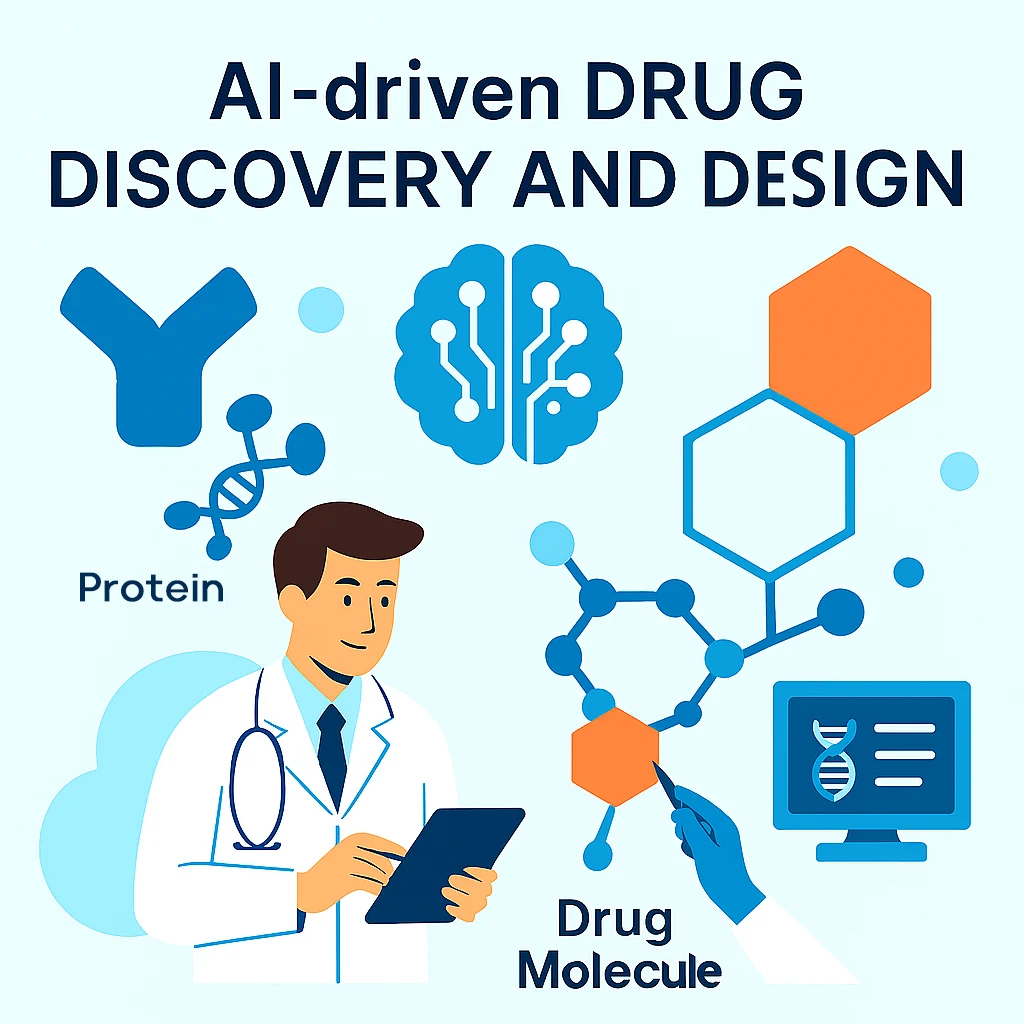
AI-driven Drug Discovery and Design
Introduction to Drug Discovery and Design
Drug discovery and design lie at the heart of modern medicine, shaping the development of therapies that address unmet clinical needs across diverse diseases. The process begins with identifying a biological target—such as a protein, enzyme, or receptor—that plays a critical role in a disease pathway. Once the target is validated, researchers search for or design molecules capable of modulating its function, either to inhibit, activate, or fine-tune its activity. Traditionally, this relied heavily on serendipitous findings or labor-intensive screening of natural products and chemical libraries. Today, however, advances in molecular biology, high-throughput screening, and computational tools have made drug discovery a more systematic, rational, and predictive endeavor.
The design phase integrates medicinal chemistry, computational modeling, and structural biology to create drug candidates with optimal pharmacological properties. Rational drug design strategies leverage detailed knowledge of target structure and function to engineer molecules with higher specificity and potency. Complementing this, computer-aided drug design and AI-driven platforms accelerate the identification of novel chemical scaffolds, optimize drug-likeness, and predict ADMET properties before synthesis. Together, these approaches streamline the path from concept to candidate, reducing costs and timelines while improving the likelihood of clinical success.
Despite these advances, drug discovery and design face persistent challenges. One of the most significant is the extremely high attrition rate, as the majority of drug candidates fail during preclinical or clinical testing due to unforeseen toxicity or lack of efficacy. Another challenge lies in the complexity of human biology, where disease mechanisms often involve networks of interactions that are difficult to capture with single-target approaches. The rising costs and time demands of drug development also pose major barriers, as bringing a single drug to market can take more than a decade and billions of dollars. Data quality and reproducibility issues in both experimental and computational methods further complicate progress, while ethical considerations around personalized medicine, gene editing, and AI-driven drug design continue to emerge.
The workflow of drug discovery typically follows a stepwise path: target identification and validation, hit discovery through screening or design, lead optimization guided by structure–activity relationships, preclinical testing in cellular and animal models, and finally, clinical trials in humans. Each stage involves iterative refinement, where feedback from experiments and computational analyses is used to improve candidate molecules. Increasingly, interdisciplinary collaboration—between chemists, biologists, computational scientists, and clinicians—is recognized as essential for success in this complex process.
By combining traditional methods with cutting-edge computational and AI-driven innovations, modern drug discovery and design aim to make the process more efficient, cost-effective, and precise. While challenges remain, the integration of advanced tools and a deeper understanding of biology are steadily reshaping the field, bringing transformative therapies closer to patients worldwide.
Fundamentals of Artificial Intelligence and Machine Learning in Life Sciences
Artificial intelligence (AI) and machine learning (ML) have emerged as transformative forces in the life sciences, enabling researchers to analyze complex biological data, model intricate systems, and accelerate discovery in ways that were once unimaginable. At their core, these technologies rely on algorithms capable of detecting patterns, learning from large datasets, and making predictions that guide experimental design and therapeutic innovation. In life sciences, this often means integrating data from genomics, proteomics, metabolomics, medical imaging, and clinical records to uncover hidden relationships and actionable insights.
The fundamentals of AI and ML in this context include supervised learning, where algorithms are trained on labeled data to predict outcomes such as disease risk or drug response; unsupervised learning, which identifies natural clusters or patterns in biological datasets; and reinforcement learning, which iteratively improves decision-making strategies, such as in drug design or treatment optimization. Neural networks, particularly deep learning architectures, have demonstrated remarkable success in tasks like protein structure prediction, image-based diagnostics, and high-throughput compound screening. By automating analysis and learning from vast biomedical datasets, AI and ML empower researchers to move from raw information to biological understanding with unprecedented efficiency.
Applications are already reshaping research and healthcare. In diagnostics, AI models trained on imaging data detect tumors, cardiovascular anomalies, and neurological conditions with accuracy rivaling human experts. In genomics, ML tools identify disease-associated variants and predict the functional consequences of mutations. In drug discovery, AI accelerates target identification, molecular design, and ADMET prediction, shortening the timeline for therapeutic development. Even in personalized medicine, algorithms integrate genomic and clinical data to tailor treatments to individual patients, promising better outcomes and reduced side effects.
Yet, the integration of AI and ML into life sciences is not without challenges. One of the biggest obstacles is data quality—biological datasets are often noisy, incomplete, or biased, which can undermine model reliability. Interpretability remains another critical issue, as many AI models operate as “black boxes,” making it difficult for researchers and clinicians to understand the reasoning behind predictions. Computational cost is also significant, particularly for deep learning, which requires powerful hardware and substantial energy resources. Ethical concerns around data privacy, algorithmic bias, and equitable access to AI-driven healthcare further complicate adoption. Finally, validation and translation into clinical practice demand rigorous testing, as models must not only perform well in silico but also prove robust in real-world settings.
The workflow of applying AI and ML in life sciences often begins with collecting and curating large-scale datasets, ensuring that they are clean, representative, and well-annotated. Models are then selected or designed depending on the task, trained on subsets of the data, and validated against independent test sets to ensure generalizability. Successful models are further refined and integrated with experimental or clinical workflows, creating a feedback loop between computation and biology. With continuous advances in algorithms, data integration, and computational power, AI and ML are becoming indispensable tools for understanding life at every scale—from molecules to populations.
By mastering these fundamentals and addressing the challenges of data, interpretability, and ethics, the life sciences community is laying the foundation for a new era of discovery. AI and ML not only enhance research productivity but also hold the potential to reshape medicine, ushering in a future where biology and computation converge to deliver precise, efficient, and personalized healthcare solutions.
Data Sources and Drug Databases
In modern drug discovery and biomedical research, data sources and drug databases form the backbone of computational and experimental workflows. These resources provide structured collections of information about chemical compounds, biological targets, disease pathways, clinical outcomes, and pharmacological properties. By aggregating and standardizing vast amounts of data, drug databases allow researchers to identify patterns, make predictions, and guide decision-making at every stage of drug development. From early-stage target identification to late-phase clinical validation, access to reliable and comprehensive datasets ensures that researchers can build upon existing knowledge rather than starting from scratch.
Several widely used drug databases serve different but complementary purposes. For chemical and structural information, resources such as PubChem and ChEMBL offer millions of compounds with annotated biological activity data. DrugBank integrates chemical, pharmacological, and pharmaceutical data with clinical trial information, making it a cornerstone for translational research. Protein Data Bank (PDB) provides 3D structural information for proteins and complexes, essential for molecular docking and rational drug design. Other specialized databases like PharmGKB focus on pharmacogenomics, linking genetic variations to drug response, while ClinicalTrials.gov offers insights into ongoing and completed trials that inform clinical relevance. Together, these resources create a comprehensive ecosystem of knowledge that supports both academic and industrial research.
Despite their critical importance, several challenges limit the effective use of drug databases. One key issue is data quality—datasets may contain errors, inconsistencies, or missing values that reduce their reliability. Another problem is heterogeneity, as databases are often built using different standards, making integration across multiple resources difficult. Many databases also suffer from limited coverage, particularly for novel chemical space, rare diseases, or understudied targets. Data bias, especially toward well-studied molecules or diseases, can skew algorithmic predictions and hinder innovation. Accessibility and licensing restrictions further complicate matters, as some high-quality databases are proprietary and costly, limiting equitable access for academic researchers. Finally, keeping databases up to date with rapidly evolving biomedical knowledge remains a persistent challenge.
The workflow of using drug databases typically involves querying specific molecules, targets, or pathways, retrieving relevant datasets, and integrating them into computational pipelines such as virtual screening, molecular docking, or machine learning models. Researchers may also combine multiple data sources to cross-validate findings, improving robustness and reliability. Increasingly, AI and natural language processing tools are being applied to automatically mine biomedical literature and clinical data, expanding databases with new insights in real time.
By overcoming challenges of data quality, integration, and accessibility, drug databases and data sources will continue to serve as essential pillars of drug discovery. They not only accelerate innovation by providing researchers with curated knowledge but also enhance reproducibility and transparency in biomedical science, ensuring that future therapies are built on a foundation of reliable and comprehensive data.
AI-based Modeling of Molecular Structure and Function
Artificial intelligence has rapidly emerged as a transformative tool in computational biology, particularly in modeling the structure and function of biomolecules. By leveraging advanced algorithms, machine learning, and deep neural networks, AI enables the prediction of complex molecular conformations and interactions that were once difficult or impossible to determine with conventional experimental or computational methods. The breakthrough of AlphaFold in protein structure prediction has already reshaped structural biology, proving that AI can achieve near-atomic accuracy in modeling proteins. Beyond structural prediction, AI-based systems are being used to study ligand–receptor binding, enzyme kinetics, and conformational dynamics, offering a new level of insight into how molecules function at the atomic scale.
The applications of AI in molecular modeling extend across drug discovery, enzyme engineering, and personalized medicine. Pharmaceutical companies employ AI-driven platforms to accelerate virtual screening of drug candidates, reducing the time and cost required for preclinical development. In protein engineering, AI models assist in designing enzymes with enhanced stability or catalytic efficiency, while in genomics and precision medicine, AI helps predict the functional impact of mutations on protein folding and signaling pathways. These capabilities bridge the gap between raw sequence data and actionable therapeutic strategies, making AI indispensable for modern life sciences.
Despite its transformative potential, AI-driven molecular modeling faces several challenges. One major limitation is the dependence on large, high-quality datasets, as biased or incomplete data can result in inaccurate models. The “black box” nature of many AI algorithms also reduces interpretability, making it difficult to validate or explain predictions in a mechanistic way. Computational cost is another barrier, since training and deploying large-scale AI models require significant hardware resources. Furthermore, while AI has shown remarkable success in well-studied proteins and ligands, generalizing predictions to novel or underexplored biomolecular systems remains problematic. Finally, translating AI-generated insights into experimentally verifiable outcomes demands careful integration with laboratory workflows, which can slow adoption in industrial and clinical settings.
The process of AI-based molecular modeling typically involves several steps. Datasets containing structural or biochemical information are first collected and curated, often from protein databanks, chemical libraries, or high-throughput screening assays. These datasets are then used to train machine learning algorithms or deep learning architectures capable of recognizing patterns in molecular interactions. Once trained, the models can predict 3D structures, binding affinities, or dynamic behaviors of molecules with remarkable speed. Outputs are validated against experimental data or higher-level computational simulations such as molecular dynamics, ensuring reliability and accuracy. With continuous improvements in algorithm design, training strategies, and computational efficiency, AI-based molecular modeling is increasingly becoming a practical and scalable approach for guiding both basic research and therapeutic innovation.
By systematically addressing issues of data quality, algorithm transparency, and experimental integration, AI-based modeling holds the promise of revolutionizing structural biology, rational drug design, and personalized medicine. As the technology matures, it is poised to serve not only as a predictive engine but also as a creative partner in designing novel molecules with optimized structures and functions, ultimately reshaping the future of biomedical discovery.
Drug Design Using Generative Algorithms
Generative algorithms are redefining the landscape of drug discovery by enabling the creation of entirely new molecular entities rather than relying solely on existing chemical libraries. Unlike traditional approaches, which depend on screening millions of known compounds, generative models such as variational autoencoders (VAEs), generative adversarial networks (GANs), and reinforcement learning systems are capable of learning the “rules” of chemical space from large datasets and then producing novel molecular structures with desired properties. This ability allows researchers to explore vast, uncharted regions of chemical space, dramatically accelerating the search for drug candidates.
The applications of generative algorithms in drug design are already being realized across pharmaceutical research. These models can design molecules optimized for binding affinity, selectivity, solubility, or toxicity profiles, significantly reducing trial-and-error cycles. In oncology, for example, generative AI has been used to rapidly propose inhibitors for kinases and epigenetic regulators, while in infectious diseases it has generated candidate antivirals within weeks of target identification. Beyond small molecules, generative algorithms are increasingly applied to peptides and proteins, expanding their relevance to biologics and advanced therapeutics. By integrating predictive models for ADMET properties, these tools streamline the pipeline from hit identification to lead optimization.
Despite their promise, generative algorithms face important limitations. One major challenge is synthetic feasibility, as many AI-generated molecules may be chemically unstable or difficult to produce in the laboratory. Data bias presents another obstacle, since models trained on incomplete or non-representative datasets can fail to generalize, producing compounds that resemble existing chemistries rather than truly novel ones. Interpretability is also limited—understanding why an algorithm proposes a specific structure remains difficult, complicating decision-making for medicinal chemists. Computational cost can be substantial, particularly for reinforcement learning frameworks that require iterative optimization. Finally, the transition from virtual molecules to experimentally validated drug candidates remains resource-intensive, and discrepancies between in silico predictions and biological reality continue to pose risks.
The workflow of drug design using generative algorithms typically begins with large molecular datasets that are encoded into a latent chemical space. Generative models explore this space to propose novel compounds that meet predefined objectives, such as high predicted binding affinity or improved pharmacokinetics. These proposed molecules are filtered using predictive models and prioritized based on their drug-likeness and ADMET characteristics. Medicinal chemists then select top candidates for synthesis, which are experimentally validated in vitro and in vivo. Feedback from these experiments is fed back into the generative model, creating an iterative cycle that improves performance and relevance over time.
By systematically addressing challenges related to synthesis, interpretability, and validation, generative algorithms are poised to become central tools in drug discovery. Their capacity to rapidly generate, evaluate, and refine novel compounds opens the door to more efficient pipelines and innovative therapies, transforming the way new medicines are conceived and developed.
Target Identification with AI
Target identification is the first and perhaps most critical step in the drug discovery pipeline, as the success of an entire therapeutic program depends on selecting the right biological target. Artificial intelligence (AI) is revolutionizing this process by enabling researchers to analyze vast and heterogeneous datasets—ranging from genomics and transcriptomics to proteomics, imaging, and clinical records—with unprecedented depth and speed. AI models can uncover hidden correlations, identify disease-associated genes or proteins, and predict causal relationships that would be nearly impossible to detect with traditional bioinformatics. By integrating multiple omics layers, AI-driven approaches provide a systems-level understanding of disease mechanisms, guiding the selection of targets that are both biologically relevant and therapeutically actionable.
The value of AI-based target identification is already evident across therapeutic areas. In oncology, machine learning algorithms have been used to prioritize tumor-specific vulnerabilities by analyzing mutational signatures and expression profiles. In rare and complex diseases, AI can sift through noisy and limited datasets to highlight novel targets that were previously overlooked. Pharmaceutical companies are increasingly deploying these approaches to reduce the attrition rate in clinical development, ensuring that resources are invested in targets with a higher probability of success. Beyond drug discovery, AI-driven target identification also plays a role in personalized medicine, helping clinicians match therapies to patient-specific molecular profiles.
Despite its transformative potential, AI-based target identification faces important challenges. One major issue is data quality and availability—biomedical datasets are often incomplete, biased, or inconsistent, which can lead to misleading predictions. The interpretability of AI models is another concern, as black-box algorithms may suggest targets without providing mechanistic explanations, making experimental validation more difficult. Integration of heterogeneous data sources, such as combining omics with clinical outcomes, requires sophisticated computational pipelines and careful normalization. Reproducibility across laboratories and populations remains a critical hurdle, as models trained on specific cohorts may fail to generalize. Furthermore, the experimental validation of AI-predicted targets is resource-intensive and can limit the speed of translation to the clinic.
The workflow for AI-driven target identification typically involves curating large-scale datasets from public repositories, clinical trials, or proprietary studies. These datasets are preprocessed to remove noise and harmonize features before being fed into machine learning or deep learning models. Algorithms are then trained to detect associations between molecular features and disease phenotypes, producing ranked lists of candidate targets. These predictions are cross-validated with known biology and prioritized for downstream experimental studies, such as CRISPR screens or high-throughput assays. Iterative feedback between computational models and wet-lab experiments helps refine predictions, improving the likelihood of identifying robust, druggable targets.
By overcoming challenges related to data quality, interpretability, and validation, AI is establishing itself as a cornerstone in modern target discovery. Its ability to integrate diverse sources of biomedical information and highlight actionable insights not only accelerates the drug discovery process but also enhances precision medicine by ensuring that therapies are developed against the most promising molecular targets.
AI-enhanced 3D Structure Design and Molecular Docking
The integration of artificial intelligence into 3D structure design and molecular docking is transforming computational drug discovery. Traditionally, molecular docking has relied on approximations of binding interactions between ligands and targets, often limited by the accuracy of structural models and scoring functions. With AI-enhanced approaches, protein and ligand structures can be generated or refined at near-atomic resolution, and docking simulations are guided by deep learning models trained on large datasets of experimentally validated interactions. This synergy enables faster, more accurate prediction of binding affinities and poses, while simultaneously exploring larger chemical spaces than conventional docking tools could handle. AI not only improves docking precision but also accelerates the early stages of drug development by suggesting promising candidates with better confidence.
Applications of AI-driven docking are rapidly growing. Pharmaceutical companies employ these tools to virtually screen millions of compounds against difficult or novel targets, significantly reducing the cost and time of hit discovery. Beyond small molecules, AI-enhanced docking has been extended to peptides, antibodies, and nucleic acids, broadening its impact across therapeutic modalities. By coupling with AI-generated 3D protein structures—such as those predicted by AlphaFold—molecular docking can now address targets that previously lacked experimental structures. Moreover, reinforcement learning algorithms can iteratively optimize ligands to improve docking scores, creating a closed loop of design, evaluation, and refinement that accelerates lead optimization.
Despite these advances, several challenges remain. One major issue is the accuracy of scoring functions—AI models may improve predictions but can still misestimate binding free energies, particularly for flexible or allosteric sites. Data quality is another limitation, since training datasets often emphasize well-studied protein–ligand systems, leading to reduced performance on novel or less characterized targets. The interpretability of AI-driven docking results is limited, making it difficult for researchers to fully trust predictions without extensive validation. Computational cost is also a concern, as large-scale docking campaigns enhanced with AI still require significant GPU and CPU resources. Furthermore, translating docking predictions into experimental confirmation can be resource-intensive, and discrepancies between in silico and in vitro results remain a persistent challenge.
The workflow of AI-enhanced docking generally begins with high-quality structural data, either experimentally determined or AI-predicted. Molecules are encoded and fed into deep learning models that predict binding poses and affinities, often outperforming classical docking engines in speed and accuracy. Generative algorithms can propose new ligands, which are then iteratively docked and refined through AI-guided optimization. Top-ranked candidates are validated through molecular dynamics simulations and, eventually, experimental assays. This pipeline creates a powerful cycle of hypothesis generation and testing, greatly accelerating the transition from computational prediction to laboratory validation.
By addressing challenges related to scoring accuracy, dataset diversity, and experimental validation, AI-enhanced 3D structure design and molecular docking are poised to become essential pillars of modern drug discovery. These methods not only refine our understanding of molecular interactions but also open opportunities for designing innovative therapeutics with higher precision and efficiency.
Evaluation and Optimization of Drug Candidates
The evaluation and optimization of drug candidates represent critical phases in the drug discovery and development pipeline, bridging the gap between initial compound identification and preclinical or clinical validation. Once potential molecules are generated—whether through high-throughput screening, rational design, or AI-assisted methods—they must undergo rigorous assessment to determine their pharmacological potential. This involves a careful balance between efficacy, safety, and drug-like properties, as even the most promising molecules can fail if they lack suitable absorption, distribution, metabolism, excretion, and toxicity (ADMET) profiles. AI and computational models are increasingly being used to predict these properties early on, allowing researchers to prioritize compounds with higher chances of success.
Applications of drug candidate evaluation are wide-ranging. In vitro assays are used to test biological activity, selectivity, and cytotoxicity, while in vivo studies provide insights into pharmacokinetics and therapeutic potential. Computational methods complement these experiments by predicting solubility, permeability, and potential off-target effects, which accelerates decision-making and reduces the need for costly laboratory work. Optimization often involves modifying chemical structures to enhance potency, improve metabolic stability, or minimize toxicity. Iterative cycles of synthesis, testing, and computational refinement create a feedback loop that progressively transforms a preliminary hit into a viable lead compound.
Despite advances in methodology, significant challenges remain. One major issue is the high attrition rate, as the majority of drug candidates fail during preclinical or clinical phases due to unforeseen toxicity or insufficient efficacy. Another challenge lies in predicting complex human biology, since in vitro and animal models often fail to capture the full spectrum of human responses. Data quality and reproducibility are persistent concerns, as variability in assay conditions or computational models can lead to inconsistent results. Moreover, the optimization process itself can be resource- and time-intensive, requiring careful prioritization of which candidates to advance. Finally, translating computational predictions into experimentally confirmed outcomes remains a critical hurdle, as discrepancies between in silico models and real-world biology often emerge.
The workflow of evaluation and optimization typically begins with screening assays that assess biological activity and ADMET characteristics. Promising candidates are then subjected to structural modifications, guided by structure–activity relationship (SAR) studies and computational modeling, to improve their therapeutic index. Parallel computational simulations help predict the consequences of these modifications before experimental validation. This iterative process continues until a small number of optimized leads demonstrate both strong efficacy and acceptable safety profiles, making them suitable for advancement into preclinical development.
By systematically addressing challenges in prediction accuracy, reproducibility, and translational relevance, the evaluation and optimization of drug candidates ensure that only the most promising compounds progress through the costly stages of drug development. With the integration of AI and advanced computational tools, this process is becoming increasingly efficient, accelerating the delivery of safe and effective therapies to patients.
Edu Journey Mobile App
Online learning now in your fingertips




Sign up to receive our latest updates
Get in touch
Call us directly?
Address:
Email: