

Quality Unit (QU)
In the pharmaceutical industry, the QU is an independent organizational entity responsible for ensuring the safety, efficacy, and quality of drug products by establishing and maintaining the Pharmaceutical Quality System (PQS) and ensuring compliance with regulatory requirements, such as current Good manufacturing Practices (cGMP). The Quality Unit oversees all aspects of the product lifecycle, from development to distribution, encompassing quality assurance (QA) and quality control (QC) functions, including setting standards, testing, auditing, and investigating deviations
Establishing a strong Quality Unit in the pharmaceutical industry involves a robust quality culture, clear roles, comprehensive training, and adequate resources, while key challenges include regulatory compliance, managing complex supply chains, talent shortages, resistance to change, and keeping up with evolving GMPs and technological advancements. Successfully building and maintaining a Quality Unit is crucial for patient safety, operational consistency, and meeting stringent regulatory expectations.
Quality Unit (QU)
Key Functions of the Quality Unit
• Establishes the Pharmaceutical Quality System: The QU creates and implements the comprehensive PQS framework, which is based on international guidelines and regulatory standards like those from the FDA and ICH.
• Ensures Regulatory Compliance: It maintains adherence to all relevant national and international regulations, such as CGMPs, and ensures that all activities comply with the PQS and marketing authorizations.
• Manages Quality Control (QC) Activities: This includes performing laboratory tests on incoming components, in-process materials, packaging, and finished products using validated methods to ensure they meet specifications.
• Conducts Quality Assurance (QA) Functions: The QU audits compliance to policies and procedures, approves or rejects all GMP-related documents and materials, and investigates any non-conforming products or processes.
• Oversees Product Lifecycle: The QU’s responsibilities extend across the entire product lifecycle, including product development, manufacturing, packaging, labeling, and distribution.
• Promotes Continuous Improvement: The unit fosters a culture of continuous improvement by assessing quality systems, identifying flaws, and planning for corrective actions to enhance product quality and process capability.
• Maintains Independence: To ensure objective quality decisions, the Quality Unit must remain independent from production and other functional areas
Key Aspects of Quality Unit Establishment
Quality Culture:
Fostering a mindset where quality is ingrained in every aspect of the organization, requiring a cultural shift and consistent executive management support.
Clear Roles and Responsibilities:
Defining specific roles and responsibilities within the Quality Unit to ensure proper oversight and decision-making processes.
Robust Data Governance:
Implementing strong data governance systems to ensure data integrity and support decision-making.
Employee Training:
Providing adequate training, communication, and continuous education programs to empower employees with the necessary knowledge and skills.
Resource Allocation:
Allocating sufficient resources, including technology and infrastructure, to effectively support quality initiatives.
Quality by Design (QbD):
Adopting innovative and systematic approaches like QbD, which emphasizes understanding product and process characteristics from the outset to build quality in, rather than relying solely on testing.
Common Challenges
Regulatory Compliance: Navigating complex and ever-changing regulatory requirements and evolving GMP standards.
Supply Chain Management: Overcoming deficiencies, including late deliveries, staffing challenges, and unavailable Active Pharmaceutical Ingredients (APIs).
Talent Shortage: A general shortage of qualified personnel in the pharmaceutical sector.
Resistance to Change:
Overcoming internal resistance to new quality systems and a quality culture.
Resource Limitations: Financial challenges in allocating sufficient resources for quality initiatives, especially for smaller companies.
Technological Advancement: Keeping up with the pace of new digital technologies and the complexities of scaling up from laboratory to commercial production.
Overly Stringent Specifications: The risk of overly strict specifications leading to unnecessary recalls and drug shortages.
Data Security: Addressing growing concerns around data security and cyber threats.
Quality Metrics for Drug Manufacturing
• Chemistry, Manufacturing, and Controls Development and Readiness Pilot (CDRP) Program
• Search for Pharmaceutical Quality Documents
• Current Good Manufacturing Practice (CGMP) Regulations
• CDER Quality Management Maturity
• Q&A on CGMP Requirements
• Inspection | Enforcement Resources
• Questions and Answers on Quality-Related Controlled Correspondence
What are Quality Metrics (QM)?
QMs are an objective way to measure, evaluate, and monitor the product and process lifecycle. Quality metrics data may lead to higher levels of safety, efficacy, delivery, and performance.
Quality metrics are used throughout the drug and biological product industry to monitor processes and drive continuous improvement efforts in manufacturing. Effective use of quality metrics is one characteristic of robust site Quality Management Maturity (QMM).
Why are Quality Metrics Important?
The minimum standard for ensuring that a manufacturer’s products are safe, effective and of sufficient quality is compliance with current good manufacturing practice (CGMP) requirements. CGMP compliance alone, however, does not indicate whether a manufacturer is investing in improvements and striving for sustainable compliance, which is the state of having consistent control over manufacturing performance and quality. Sustainable compliance is difficult to achieve without a focus on continual improvement.
An effective Pharmaceutical Quality System (PQS) ensures both sustainable compliance and supply chain robustness. Quality metrics can contribute to a manufacturer’s ability to develop an effective PQS because these data provide insight into manufacturing performance and enable the identification of opportunities for updates and innovation to manufacturing practices. Quality metrics also play an important role in supplier selection and can inform the oversight of contract activities and material suppliers, as well as help determine appropriate monitoring activities to minimize supply chain disruptions. Quality metrics data from establishments can also have utility to the FDA:
Assist in developing compliance and inspection policies and practices.
Improve prediction and possibly mitigation of future drug shortages, while encouraging the pharmaceutical industry to implement innovative quality management systems for manufacturing.
Enhance FDA’s risk-based inspection scheduling, reducing the frequency and/or length of routine surveillance inspections for establishments with quality metrics that suggest sustainable compliance. Provide ongoing insight into an establishment’s operations between inspections.
How Can Quality Metrics be used at FDA?
As part of FDA’s ongoing adoption of risk-based regulatory approaches, the agency is proposing to develop and implement a Quality Metrics Reporting Program to support its quality surveillance activities. Under this program, the FDA intends to analyze the quality metrics data submitted by establishments to:
obtain a more quantitative and objective measure of manufacturing quality and reliability at an establishment; integrate the metrics and resulting analysis into FDA’s comprehensive quality surveillance program; and
apply the results of the analysis to assist in identifying products at risk for quality problems (e.g., quality-related shortages and recalls).
Background on FDA’s QM Program
In 2004, FDA issued the report “Pharmaceutical CGMPs for the 21st Century – a Risk-Based Approach”. In 2014, FDA gained additional insight when the Brookings Institute collaborated with FDA to convene an expert workshop, “Measuring Pharmaceutical Quality through Manufacturing Metrics and Risked-Based Assessment”, which provided an opportunity for pharmaceutical manufacturers, purchasers, regulators, and other stakeholders to discuss the goals, objectives, and challenges for a pharmaceutical QM program.
In July 2015, FDA issued the draft guidance Request for Quality Metrics (80 FR 44973), which described a proposed mandatory program for product-based reporting of quality metrics. Under this program, manufacturers would have submitted four primary metrics. Stakeholder comments on the guidance included concerns regarding the burden associated with collecting, formatting, and submitting data at a product level across multiple establishments; technical comments on the proposed metrics and definitions; and legal concerns regarding the proposed mandatory program. Stakeholder commenters also suggested a phased-in approach to allow learning by both industry and FDA.
In response to this feedback, FDA published a revised draft guidance in November 2016 entitled Submission of Quality Metrics Data (81 FR 85226). The 2016 guidance described an initial voluntary phase of the QM Reporting Program, with participants reporting data either by product or establishment, through an FDA submission portal. FDA removed one of the four metrics from the 2015 draft guidance and requested submission of the remaining three key metrics. This 2016 guidance also described how FDA intended to utilize the submitted data. Commenters requested a better understanding of the value and utility of the data to be submitted to FDA and how FDA would measure success of the program. Commenters also expressed a preference for a pilot program to gather industry input before implementing a widespread Quality Metrics Reporting Program.
In Federal Register notices issued in 2018, FDA announced the availability of two pilot programs, a Quality Metrics Site Visit Program (83 FR 30751) and a Quality Metrics Feedback Program (83 FR 30748) for any establishment that had a quality metrics program developed and implemented by the quality unit and used to support product and process quality improvement. Additional information and lessons learned by FDA can be found on the FDA Quality Metrics Reporting Program; Establishment of a Public Docket; Request for Comments.
In March 2022, FDA established a docket to solicit comments on changes to FDA’s previously proposed Quality Metrics Reporting Program. This notice describes considerations for refining the Quality Metrics Reporting Program based on lessons learned from two pilot programs with industry that were announced in the Federal Register in June 2018, a Site Visit Program and a Quality Metrics Feedback Program, as well as stakeholder feedback on FDA’s 2016 revised draft guidance for industry Submission of Quality Metrics Data.
Common Compliance Issues in the Pharmaceutical Industry (and How to Avoid Them)
The US FDA releases an annual report summarizing observations from inspections by industry. The pharma industry in 2018 received 3,344 observations for 390 categories of noncompliance. Almost a third of these observations (39% of them) can be divided into just ten categories, thus illustrating the common challenges of pharmaceutical compliance.
However, the results become even more apparent when you group the data into categories based on the top ten reasons.
The four-and-a-half-dozen organizations received a 483-letter relating to noncompliance for creating or following procedures or problems with record-keeping. Additionally, 322 of the pharmaceutical industries had difficulty designing and implementing adequate controls, and 137 had trouble maintaining their products.
Whenever a pharmaceutical startup or scale-up approaches market approval, it is customary to go through growing pains. A laboratory manager may discover that a batch of maintenance records was not reviewed the week before he went on vacation, for example, even though your means of doing things seem to be working. Fortunately, there is an easier way to handle an FDA inspection than simply hoping for the best.
1. Lack of Clearly Defined Procedures and SOPs
In a Standard Operating Procedure (SOP), clear steps are outlined for carrying out specific tasks in the workplace. Using an SOP simplifies communication and makes it easier to perform the necessary functions for the work to move forward. However, compliance issues tend to arise due to a lack of effective SOPs/Written Procedures.
Various issues prevent creating and using SOPs, including complicated language, lack of standardization, and inadequate training.
Related Articles: Workplace Productivity Depends on Employee’s Training and Development
2. Inadequate Maintenance Facilities
During 2018, more than 2% of the FDA observations were for inadequate cleaning, sanitizing, and maintenance. Sanitizing, maintaining, and cleaning equipment and utensils appropriately must comply with the FDA Code of Federal Regulations.
The company should clearly outline the methods for cleaning and maintaining hygienic conditions. For example:
Providing clear instructions for cleaning.
Indicating who is responsible.
Planning your cleaning schedule.
Providing the guidelines for maintaining the equipment properly.
Ensuring regular inspections and protective measures for equipment.
Additionally, it is essential to maintain cleaning activities logs and update them as often as other operational logs.
3. Not properly utilizing data
Real-time access to data allows companies to stay abreast of changes in compliance and improve performance. By doing this, an organization can minimize the effects of non-compliance effectively. Unfortunately, one of the key reasons that organizations cannot utilize the available data is outdated technology.
Compiling data from legacy systems is challenging. Most legacy systems provide incorrect data, and integrating new data is a complex process. It further keeps pharma companies from compliance reporting. Organizations often lack adequate reporting systems. To solve this problem, they use manual reporting systems, but they are susceptible to error. Additionally, the long-term costs are high. Companies should prioritize compliance needs and failing to do so could have dire consequences.
4. Inadequate laboratory control
About 4% of all FDA observations in 2018 concerned failed laboratory controls. To maintain the laboratory data, it is necessary to monitor and maintain the laboratory controls. In addition, raw data can help determine many items, from instrument calibration to employee compliance to SOP adherence- which can prevent problems from arising.
5. A lack of communication and collaboration
A SOP without clarified roles and responsibilities creates ambiguity. The employee is better able to perform their duties and remain compliant with standards if they correctly understand what is expected of them. Moreover, providing compliance training at regular intervals keeps them prepared for the unforeseen challenges they may face in their tasks. It would be best if you equip them with tools so they can communicate, collaborate, and learn new skills. For example, you can utilize a next-generation training management software to manage employee training while giving them a centralized platform to communicate and collaborate.
6. Participation among departments is low.
Developing an SOP isn’t a linear process. You must update it to keep it current. It shouldn’t be the responsibility of one department to create and maintain these documents. To ensure that the SOPs remain relevant, departments that use them need to collaborate and update them as required. In addition to encouraging feedback, employees will offer suggestions for improvements. It will help maintain a culture of quality and continuous improvement. You may need a good Change Control Software to manage changes in processes, documents, facilities, and more.
7. Faulty Product Review Records
To avoid omissions, the review and investigation processes must be clearly defined. Several ways are available for organizations to become out of compliance with CFR 211.192, which include:
Failure to perform a thorough log review
Reviewing downtime, cleaning, and clearance logs is a must
Process failures
Lab workers can’t examine their records
Lack of standardization
An operational team and the quality control unit should use a single set of standards and standard operating procedures for batch record review to prevent any misunderstandings.
It is unacceptable for a pharmaceutical company to receive a 483-letter due to its first FDA inspection. The 483 letter signifies that your organization is out of compliance, even if you have corrected the problem. The long-term costs of uncorrected quality and operational issues outweigh the cost of continuously following FDA best practices.
The causes of noncompliance with cGMP are rarely willful. Typically, 483 observations are the result of oversights. This may be the case as the laboratory manager forgot to review maintenance records after a week on vacation. An older copy of the SOP may be used by lab employees who lost the updated document. A broken workflow or collaboration may result in noncompliance issues or simply human error. Fortunately, your quality management system can help you avoid many of these issues.
Do you worry about getting an FDA 483 Form letter or a warning letter?
A Form 483 observation and a Warning Letter are not the same.
A Form 483 is a preliminary notice of potential violations observed during an FDA inspection, while a Warning Letter is a more serious, formal enforcement action taken when observations from a 483 are not adequately addressed, and it signals the potential for greater consequences. The 483 is an informal discussion tool between the FDA investigator and the company, whereas the Warning Letter is a formal, public document that requires a prompt and adequate corrective action plan.
FDA Form 483 (Notice of Inspectional Observations): A document provided by an FDA investigator at the end of an inspection, listing conditions that appear to violate the Food, Drug, and Cosmetic Act or other regulations.
• Purpose: To discuss the findings with the company and provide an opportunity for them to provide information or take corrective actions.
• Seriousness: Less severe than a Warning Letter; it is not a final determination of a violation.
• Publicity: Generally not made public, although they can be purchased.
• Requirement to Act: A company is encouraged to respond with corrective actions but is not legally obligated to act on the observations.
FDA Warning Letter: A formal, written notification from the FDA to a regulated company detailing significant violations of FDA regulations.
• Purpose: To formally state the severity of the violations and indicate the FDA’s intent to take further enforcement action if the company fails to promptly and adequately resolve the issues.
• Seriousness: A significant escalation from a 483, indicating serious compliance failures that may impact public health.
• Publicity: A public document that is posted on the FDA website.
• Requirement to Act: A company is legally required to address the concerns and make necessary changes
A warning letter is a formal, written communication from an employer to an employee/ a regulatory agency to a company, detailing a specific violation of policies, rules, or laws. Its purpose is to formally document misconduct or performance issues, clearly state expectations for improvement, and outline the consequences of not taking corrective action, such as further disciplinary measures or legal action. Warning letters serve as a record of the issue and provide a formal opportunity for the recipient to address and resolve the problem.
• Purpose: To formally address performance problems or violations of company policy that an employee needs to improve.
• Contents: Should include the specific issue, factual examples, dates, the impact of the behavior, clear steps for improvement, and potential consequences like termination.
• Goal: To give the employee a documented opportunity to correct their behavior and prevent future issues.
Key characteristics of a warning letter:
• Formality: Uses a formal tone and often requires a signature to acknowledge receipt.
• Specificity: Clearly outlines the exact issue and provides concrete examples, dates, and relevant details.
• Documentation: Creates a formal record of the problem and the steps taken to address it.
• Corrective Action: Provides clear, actionable steps for the recipient to take to resolve the issue.
• Consequences: Warns of potential repercussions if the behavior or violation is not corrected.
An FDA 483, formally the Notice of Inspectional Observations, is a document issued by the U.S. Food and Drug Administration (FDA) to companies after an inspection to detail conditions or practices that may violate the Food, Drug, and Cosmetic Act (FD&C Act) or other regulations. It serves as a formal notification from the investigator to the inspected company’s management about potential issues, but it is not a final determination of noncompliance. Companies are expected to provide a response to the observations, outlining their corrective actions to bring the facility into compliance.
According to FDA data, 3,344 observations were written to pharmaceutical firms in 2024. However, the best time to stay in compliance with cGMP for quality is before you feel the consequences of a failing inspection. The best way to ensure you don’t get a 483 is to focus on the 7 most common and likely areas and compliance issues that cause them and how you can handle them.
Challenges in pharmaceutical Quality Assurance (QA)
stringent and evolving global regulations, complex supply chains, ensuring data integrity in digital systems, attracting and retaining skilled talent, the transition from manual to digital/automated processes, communication gaps between departments, and pressure to control costs while maintaining high quality and compliance standards.
Regulatory Challenges
• Evolving Global Regulations: Pharmaceutical companies must navigate a complex and constantly changing landscape of regulations from bodies like the FDA and EMA, requiring constant updates and training for QA teams.
• Documentation: Meticulous record-keeping is essential, but managing the sheer volume of documentation and ensuring its accuracy is a significant challenge.
Process and Technology Challenges
• Complex Manufacturing Processes: The intricate nature of pharmaceutical manufacturing necessitates robust QA systems and continuous monitoring to ensure consistency and compliance across all stages.
• Data Integrity: With increasing use of electronic systems, ensuring the accuracy, security, and traceability of data is a top priority.
• Technology Integration: Adapting to and integrating new digital workflows, electronic systems, and automation can be difficult and requires significant investment in training and new infrastructure.
Operational & Human Resource Challenges
• Talent Shortage: There is a high demand for specialized QA professionals, making it difficult to attract and retain skilled individuals.
• Communication Gaps: Coordinating effectively with various departments, including production, research, and regulatory affairs, can be challenging.
• Supply Chain Management: Ensuring quality across a complex global supply chain requires strong supplier qualification and management processes.
• Cost Pressure: The need to balance high-quality standards and strict compliance with pressure to reduce costs is an ongoing challenge.
The primary challenges in pharmaceutical Quality Control (QC)
Regulatory compliance with complex, evolving global standards, data integrity issues and management, supply chain complexities, the need to keep pace with digitalization and technological advancements, maintaining a strong quality culture, and ensuring product quality amidst raw material variability, contamination risks, and increasing market demand.
Key Challenges in Pharmaceutical QC:
• Regulatory Compliance:
• Evolving Standards: Keeping up with changing global regulations, especially regarding data integrity and validation, is a constant challenge.
• Audit-Readiness: Maintaining operations in a state of readiness for regular audits from regulatory bodies is demanding.
• Data Integrity and Digitalization:
• Data Management: Managing and integrating vast amounts of data from various sources, including manufacturing, labs, and audits, is complex.
• Digitalization Pace: QC systems must adapt to the accelerating speed of digitalization in manufacturing, requiring more integrated reporting and real-time monitoring.
• Quality Culture and Human Factors:
• Cultural Shift: Fostering a robust quality culture requires overcoming resistance to change and a fundamental shift in mindset and employee behavior.
• Employee Engagement: Ensuring active participation, adequate training, and continuous education for all employees is essential to build quality into every step.
• Resource Allocation: Securing sufficient resources for technology, infrastructure, and training can be a significant financial challenge, particularly for smaller companies.
• Operational and Product Quality Challenges:
• Raw Material Variability: Variability in raw materials and their impact on product quality is a persistent difficulty.
• Contamination Risks: Preventing cross-contamination and microbial contamination is a critical challenge, especially for sensitive products like biologics.
• Equipment and Process Management: Managing equipment malfunctions, ensuring proper cleaning, and dealing with legacy systems can impact operational efficiency.
• Supply Chain and Production Demands:
• Complex Supply Chains: Ensuring consistent quality across global supply chains, from raw material sourcing to final product delivery, is a significant task.
• Increased Speed and Efficiency: QC labs face pressure to improve operational efficiency and reduce errors to keep up with growing market demands and faster production cycles.
Pharmaceutical QMS management System
The collaboration of cross-functional teams, often across multiple sites, while ensuring strict compliance with global regulations. Some common pharmaceutical regulations include GMP, FDA 21 CFR Part 210 & 211 (21 CFR Parts 210 and 211 are United States FDA Regulations outlining the cGMP for the drug industry, with Part 210 setting the general framework and definitions, and Part 211 providing detailed requirements for finished pharmaceutical products), 21 CFR Part 11 (Electronic Records and Electronic Signatures requirements used by pharmaceutical or medical device manufacturers when they submit to the FDA), and EU GMP Annex 11 (Manufacture of Sterile Medicinal Products) among others. Any compliance mishaps can lead to a spiral of consequences, from regulatory warnings to product recalls and reputational damage.
This is no easy task for quality professionals from the industry. Maintaining a strong QMS requires balancing complex processes, ensuring high-quality and accurate documentation, and implementing effective risk management strategies, all while keeping operations efficient.
In this article, we’ll explore the most common pharma QMS challenges and provide practical solutions to help your organization stay compliant, improve efficiency, and build a culture of continuous quality improvement.
• Your audit results and management reviews feed into the QMS, enabling continuous improvement
• Establish Quality Policies with clear Quality Objectives in place.
• Your CAPA system helps improve processes continuously, address any audit findings and mitigate risks.
• There is a constant and effective analysis of data: monitoring, measuring, analyzing, and improving processes to ensure sustained quality and hitting those quality KPIs.
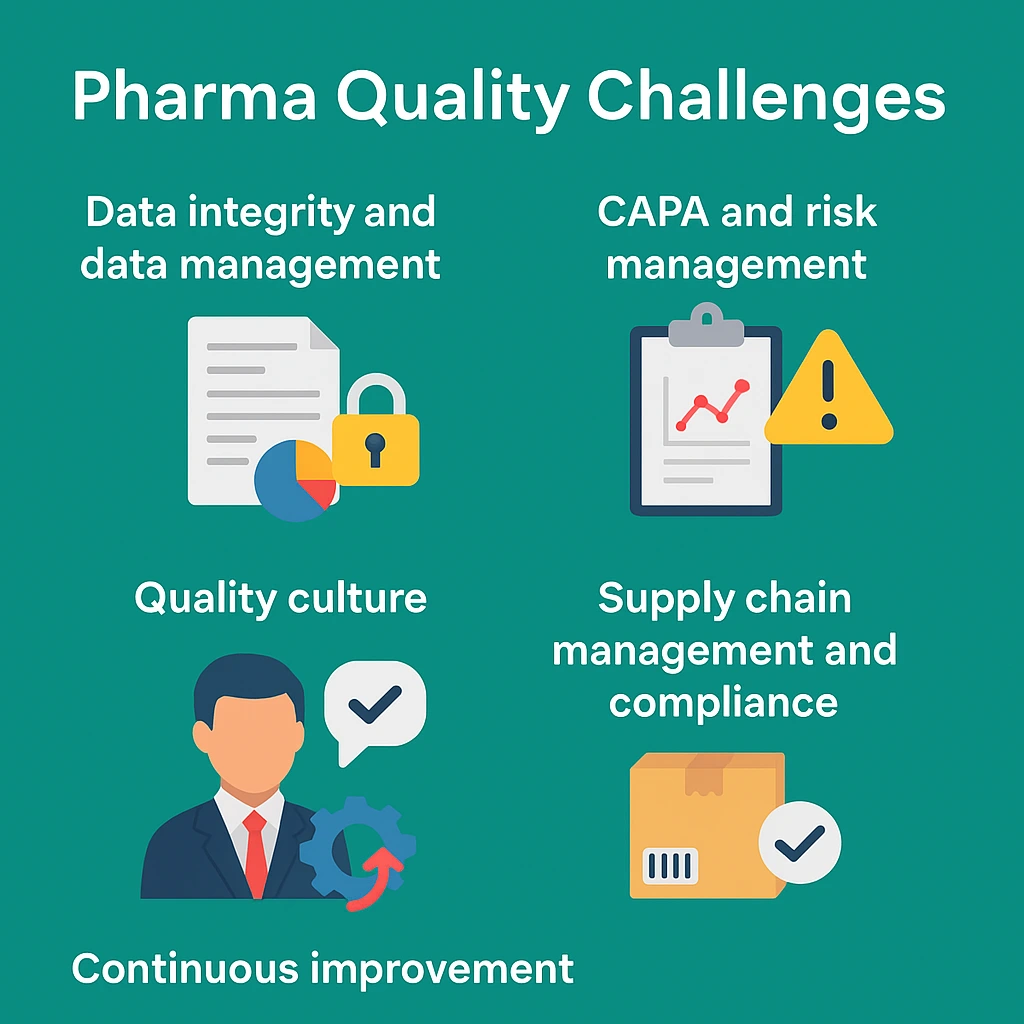
Common QMS challenges in pharma
Data integrity and data management
The life sciences industry, including pharma, generates the equivalent of 5 billion pages of text every 24 hours amounting to tens of terabytes of data every single day. As you can imagine, data storage becomes a major concern, as how you store your data impacts costs, security, and resource requirements in significant ways.
Then there’s accessibility, can you quickly pull the documents you need during an audit? If not, you’re in trouble. The lack of data standardization also complicates things.
How can you analyze and use data effectively if it’s inconsistent and scattered across different systems?
Compliance is another big factor. Is your data management in line with regulations like HIPAA? Is your data reliable, accurate, and trustworthy? Nowadays, regulators are increasingly focusing on data integrity to ensure patient safety.
Developing a strong data governance framework, designating a data steward, implementing FAIR principles, and leveraging technologies like AI and ML to analyze large datasets, identify patterns, and predict future trends can help you mitigate some of these challenges.
Data integrity and data management
The life sciences industry, including pharma, generates the equivalent of 5 billion pages of text every 24 hours amounting to tens of terabytes of data every single day. As you can imagine, data storage becomes a major concern, as how you store your data impacts costs, security, and resource requirements in significant ways.
Then there’s accessibility, can you quickly pull the documents you need during an audit? If not, you’re in trouble. The lack of data standardization also complicates things.
How can you analyze and use data effectively if it’s inconsistent and scattered across different systems?
Compliance is another big factor. Is your data management in line with regulations like HIPAA? Is your data reliable, accurate, and trustworthy? Nowadays, regulators are increasingly focusing on data integrity to ensure patient safety.
Developing a strong data governance framework, designating a data steward, implementing FAIR principles, and leveraging technologies like AI and ML to analyze large datasets, identify patterns, and predict future trends can help you mitigate some of these challenges.
CAPA and risk management
CAPA failures have been identified as one of the most common audit issues in the pharmaceutical industry in recent years. Inadequate root cause investigations, poor analysis of deviations, product failures, and customer or patient complaints, along with insufficient CAPA systems, have all contributed to these challenges.
Reactive Vs. proactive risk management is common in many pharmaceutical companies as they struggle to continuously monitor outcomes and predict risks.
Build a robust CAPA management system from the start: Use a centralized, digitized system, review it regularly, and ensure it stays current and effective. Establish clear communication guidelines, and make sure each CAPA is reviewed thoroughly with a cross-functional team involved in the process.
Early detection of deviations and nonconformities is crucial for preventing quality issues and driving improvement. What’s the ultimate goal? Prevent these issues in the first place and you can do that through effective risk based thinking and risk management strategies.
Quality culture
Resistance to change, lack of manager buy-in, a blame culture, and quality being seen as just the quality department’s job, sound familiar? These are all signs of a weak quality culture. Every quality assurance manager dreams of a strong, organization-wide quality culture, but sadly, that’s often not the reality.
Building that quality culture is a mindset shift, it requires changing the attitudes of employees used to the status quo, strong support from leadership, and decisive action. This is something that cannot be achieved overnight and is a constant struggle for quality teams as they know their QMS would be so much better if only everybody else was on board.
ISPE’s framework for cultural excellence is built on six key dimensions that drive operational greatness and assess your quality maturity:
1. Building leadership and vision
2. Challenging mindsets and attitudes
3. Active engagement through Gemba walks
4. Leading quality indicators and monitoring key triggers
5. Transparent oversight and review
6. Implementing cultural enablers (e.g., learning organizations, proactive problem-solving, and recognizing organizational change).
Continuous improvement
Quality assurance professionals are often pulled into handling immediate issues; product defects, audits, compliance concerns, or customer complaints. This reactive focus leaves little room for proactive improvement efforts, especially when day-to-day operations and regulatory compliance take priority.
At the end of the day, continuous quality improvement is about teamwork. In organizations with fragmented departments or poor communication, QA managers often struggle to align cross-functional teams around improvement initiatives, making progress slow and difficult.
Adopting one of the tried-and-true methodologies is the Lean Thinking, Six Sigma, and Kaizen.
• Lean Thinking: A continuous transformation that streamlines operations by eliminating waste while maintaining or increasing value.
• Six Sigma: A data-driven method that uses statistical analysis to detect and eliminate inefficiencies and defects, reducing process variation.
• Kaizen: A philosophy of small, incremental improvements that, over time, lead to significant process enhancements.
Supply chain management and compliance
The pharmaceutical industry is one of the most heavily regulated fields worldwide with constantly evolving standards, making compliance across various regions of the supply chain extremely difficult. This means companies must stay on top of continuously updating their processes, documentation, and training programs.
To add to the complexity, the supply chain involves multiple suppliers and manufacturers, which generates gigantic quantities of data to manage and ensure visibility and traceability. And if that wasn’t enough, let’s not forget that the supply chain is vulnerable to disruptions like natural disasters, geopolitical tensions, pandemics, and supply shortages.
Manage a supply chain: by implementing advanced technology solutions. For example, an eQMS can automate repetitive tasks and digitize records, significantly reducing manual errors and improving efficiency. Having suppliers, manufacturers, and distributors aligned on a digital platform also makes it easier to communicate and collaborate.
On the other hand, blockchain technology can further help you enhance traceability by providing a secure, immutable ledger that records every transaction, helping combat counterfeit drugs and ensuring transparency.
Siloed and hybrid quality management
Documentation is the lifeblood of quality management. When it’s managed in a fragmented way, some on paper, others in a mix of digital and paper formats, it leads to disconnected information streams across the organization.
This fragmentation makes it difficult to gain a comprehensive, real-time understanding of processes, making it extremely hard for the quality assurance team to spot potential issues early and react before they escalate. The consequences? Product quality and compliance are compromised, and collaboration becomes inefficient and frustrating.
The best way to unify your documentation and data is by embracing modern technology, like an eQMS. It brings everything together in one secure place, making your processes more efficient and easier to manage.
One of the standout benefits of eQMS is how it seamlessly integrates key QMS functions like document management, risk management, and CAPA, making data extraction for KPIs easy. With all your metrics in one spot, you can quickly spot weak areas, make better decisions, and ensure everyone stays aligned with real-time insights from anywhere.
• Make data work for you, not against you: A strong data governance framework and digital tools will help you ensure integrity, compliance, accessibility, and better decision-making.
• Quality Management should be proactive, not reactive: Strengthening quality management requires a strategic shift towards continuous improvement, proactive risk management, and a deeply ingrained quality culture.
• An eQMS will help ease most of your headaches: A well-integrated eQMS not only reduces manual errors and compliance risks but also provides real-time insights, enabling more informed decision-making and long-term operational success.
• Managing Documentation: Regulatory submissions require extensive and accurate documentation, and manually managing large volumes of data can lead to errors and inefficiencies.
• Talent and Training Gaps: Ensuring that all staff are adequately trained on complex regulations and procedures is crucial but can be challenging.
• Fraud and Corruption: The industry faces risks such as off-label promotion, kickbacks, and bribery, which require stringent controls to prevent.
Strategies to Address Challenges
• Strategic Regulatory Engagement: Early and proactive engagement with regulatory bodies helps streamline the approval process.
• Technological Integration: Utilizing advanced technologies, such as AI and data analytics, can improve data management, transparency, and operational efficiency.
• Robust (QMS): Implementing comprehensive QMS helps monitor and control processes for consistent quality and compliance.
• Employee Empowerment and Training: Investing in thorough and ongoing training programs ensures employees understand and adhere to regulatory requirements.
• Focus on Data Security: Implementing advanced access controls and secure digital communication channels is vital to protect sensitive data.
Edu Journey Mobile App
Online learning now in your fingertips




Sign up to receive our latest updates
Get in touch
Call us directly?
Address:
Email: